Glossary
(Redirected from MFX)
This page contains short (sometimes longer) definitions of common acronyms or relevant terminology used in various products covered by this wiki. Pictures are sometimes included as well for clarity's sake.
MIDI Terminology
- MIDI
- Musical Instrument Digital Interface, a universal music communication standard used across many different types of devices. Wikipedia's article on MIDI may be helpful.
- It is sometimes also used to refer to Microsoft GS Wavetable Synth or '.mid' files.
- GM
- GM1
- Stands for General MIDI. Sometimes GM1 is used to differentiate from GM2.
- GM2
- Stands for General MIDI 2.
- CAF/CAf
- Stands for Channel Aftertouch, sometimes referred to Channel Pressure (abbreviation from Roland documentation). Some MIDI keyboards feature this and is used by "pushing" the key down further after sounding it to control one or several parameters (for example using this pressure control to adjust the filter cutoff frequency of a sound)
- CC
- Stands for Continuous Control, typically followed up by a number between 0 and 127 to denote the control number. This is a MIDI message that represents adjusting a "controller", e.g. adjusting the modulation wheel. Used both for the MIDI message and for the numbered controllers that the messages use. GM–GS–XG quick reference lists some CCs.
- GS
- Roland GS standard.
- NRPN
- Stands for Non-Registered Parameter Number. This is a standard MIDI feature used for standard parameters shared between synths (e.g. General MIDI uses it). This is a MIDI concept similar to a controller (CC), but instead of sending a single CC, setting an RPN requires sending an NRPN MSB CC, NRPN LSB CC, and then Data Entry CCs (usually just Data Entry MSB). GM–GS–XG quick reference lists some NRPNs and the CCs used for them. See also NRPN.
- RPN
- Stands for Registered Parameter Number. This is a standard MIDI feature used for manufacturer-specific additional parameters (e.g. XG and GS use it). This is a MIDI concept similar to a controller (CC), but instead of sending a single CC, setting an RPN requires sending an RPN MSB CC, RPN LSB CC, and then Data Entry CCs (usually just Data Entry MSB). GM–GS–XG quick reference lists some RPNs and the CCs used for them. See also RPN.
- XG
- Yamaha XG standard.
- SMF
- Standard MIDI File. The standard format for MIDI files (usually have the ".mid" extension). The standard can be downloaded from midi.org.
Connectors
- XLR
- XLR is a connector type used in some instruments, most commonly microphones. It is circular in shape and provides three visible pins, one used for ground and the others used to create a balanced audio signal.
- 1/4" Jack
- 6.35mm Jack
- Instrument Jack
- All refers to a type of phone connector that is 1/4", or 6.35mm in length. The most common types are TS (tip-sleeve), which feature one black ring and typically provide monophonic audio, or TRS (tip-ring-sleeve), which features two black rings and typically provide stereophonic audio.
- MIDI Port
- 5-pin DIN
- Refers to the 5-pin MIDI connector, which is typically a 5-pin DIN connector.
- Barrel Jack
- DC Jack
- Coaxial Connector
- A type of direct current connector, where the unit to be powered has a hole with a pin in it, and the connector is a jack with a hole in the center. Typically denotes DC above the connector, along with a voltage/amperage rating, and sometimes a polarity (such as
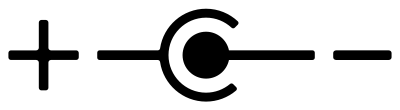 or
or 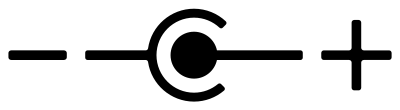 ). Check out the Power supplies article for information.
- IEC 60320 2-pin/3-pin
- Kettle Lead
- Figure-8 Lead
- Refers to
 for IEC 60320 2-pin/Figure-8 lead, or
  for IEC 60320 3-pin/Kettle Lead.
Synthesis terms
- ADSR
- Stands for Attack, Decay, Sustain, Release, used in many envelope types. The attack denotes how sharp or smooth a sound it upon being sounded (in other words, how fast to fade in), decay denotes how fast a note should decay after the attack phase is over, with sustain deciding to what level to decay to. Release then will fade the sound from the sustain level to silence in the specified amount of time.
- EFX
- It is the name of a multi-effects processor found in some Roland products, such as the Roland JV-1080[1] and Roland SC-88 Pro,[2]. It possibly is short for "effects". See also MFX.
- MFX
- It is the name of a multi-effects processor found in some Roland products, such as the Roland XV-3080[3] and XV-5080,[4]. It possibly is short for "multiple effects". See also EFX.
- SC
- Short-hand for the Roland Sound Canvas series. Can be seen in some product names, such as the SC-88.
- TVA
- Stands for Time Variable Amplifier. Works by providing both intervals (like ADSR) but also target volumes of each key point. Most often used by Roland. The "amplifier" part of this denotes that it will modify a sound's amplitude, or in other words volume.
- TVF
- Stands for Time Variable Filter. Works by providing both intervals (like ADSR) but also target volumes of each key point. Most often used by Roland. The "filter" part of this denotes that it will modify a sound's filter cut-off, which depending on the synth it is used on can be low-pass, high-pass, band-pass and so on.
References
- ↑ Roland JV-1080 Owner's Manual, page 83.
- ↑ Roland SC-88 Pro Owner's Manual
- ↑ Roland XV-3080 Owner's Manual, page 196.
- ↑ Roland XV-5080 Owner's Manual, page 306.